
Home / 2025-2026 News / Central Wyoming College Northern Arapaho Student Completes Great Divide Mountain Bike Journey
Central Wyoming College Northern Arapaho Student Completes Great Divide Mountain Bike Journey
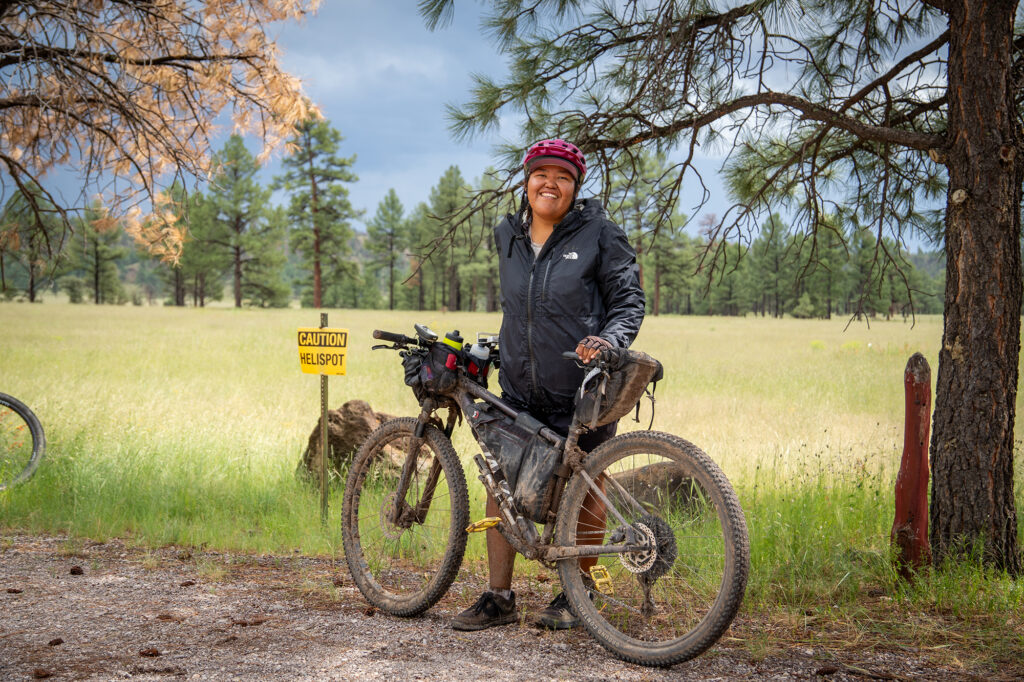
Lander, Wyo. — Central Wyoming College Northern Arapaho student Jada Antelope completed a 65-day, more than 2,700-mile bicycle journey along the Great Divide Mountain Bike Route at 10:30 a.m. on Wednesday, September 9, finishing an expedition that challenged her physically and mentally while providing opportunities for scientific research, personal growth and learning.
Antelope, along with fellow Central Wyoming College student Clint Macy and members of a 15-person expedition team, began the journey July 9 at the US/Canada border. The route carried them through remote mountain and desert landscapes along the Continental Divide, requiring riders to adapt to changing weather, difficult terrain and the demands of life on the trail.
Antelope’s Great Divide journey builds on an earlier CWC cycling expedition featured in the Wyoming PBS documentary Gravel & Grit: Bridging the Great Divide, which follows Antelope and fellow CWC students as they navigate a 1,000-mile Continental Divide journey combining cycling, scientific research and personal discovery. The film is available to stream on PBS.
For Antelope, crossing the finish line of the full route—north to south—marked the culmination of an experience that became much more than a long-distance bike ride.
“Riding the Great Divide came at a time that I needed it,” Antelope said. “Over the past year I have been working on my self-development and awareness in a controlled environment. Getting the time on my bike has helped me stay grounded before I head to the University of Wyoming.”
Antelope has been admitted to the University of Wyoming for fall 2026, making the completion of the expedition a milestone between two chapters of her education.
During the journey, she said she also gained confidence in navigating relationships, independence and time for reflection.
“I have been able to expand my social skills through living with and getting to know, a new group of people, as well as experience self-reflection time on the bike,” she said. “This has been the best learning space I’ve ever had!”
The expedition combined outdoor adventure with scientific research as part of Central Wyoming College’s BIKES — Building Integrated Knowledge & Experience in Science — initiative.
Students tested portable atmospheric monitoring technologies and contributed to equipment maintenance, camp operations, cooking and daily problem-solving while traveling the Great Divide Mountain Bike Route.
The project reflects Central Wyoming College’s broader effort to connect classroom learning with expedition science, environmental research and outdoor education.
Clint Macy documented the journey through photography and video logs and served as an operations assistant for Adventure Cycling Association, the organization hosting the ride.
Macy said the group and the changing landscape helped keep riders motivated, even during difficult portions of the route.
“You would think it might be hard to stay motivated on a trip like this, particularly during some of the really tough sections, but it’s actually quite the opposite,” Macy said. “Having a group to ride and connect with as well as stunning landscapes that change from mountains to desert in the course of a day keeps you hungry for more.”
“Not many young people are out here doing this,” he said, “which makes it feel all the more special to be closing in on the finish line.”
With the finish now behind them, the expedition represents the latest example of Central Wyoming College’s emphasis on experiential learning and undergraduate research.
Jacki Klancher, CWC’s Director of Research and Innovation, said students gain skills that are difficult to replicate in a traditional classroom when they are given responsibility in challenging field environments.
“Students undergo extraordinary transformation when we approach education as a journey that allows for knowledge gained in the classroom to be applied to undergraduate research and spectacular adventures in the backcountry,” Klancher said.
Antelope and Macy had to solve problems each day while managing fatigue, weather, uncertainty and the logistical demands of an expedition lasting more than two months, Klancher said.
“This kind of experience builds competence and confidence in a way that is very difficult to replicate,” she said.
The project was also designed to create pathways into science, education, leadership, communications and outdoor careers.
“Programs like this are not simply about getting students outdoors,” Klancher said. “They are about creating pathways into science, education, leadership and future careers and providing students with experiences that change their sense of what is possible.”
The scientific work conducted during the expedition is part of CWC’s TEMPS Project, a portable environmental sensor initiative connected to the college’s Mountain and Glacier Initiative. The project also brings together CWC programs in outdoor education, expedition science, geospatial information science and technology, and applied sciences.
Funding and research support for the scientific components of the project came from the Wyoming NASA Space Grant Consortium, the Wyoming Innovation Partnership, National Science Foundation EPSCoR programs WyACT and WySEaSON, and the LOR Foundation.
The expedition was conducted in partnership with Adventure Cycling Association, a nonprofit organization focused on bicycle travel.